Has God Stopped Speaking?
THEOLOGICAL BIBLE STUDIES
Justin Hoke
6/19/202611 min read
Many young Christians struggle with the doctrine often called cessationism. That word can sound cold, intellectual, or even spiritually lifeless. It can sound as though someone is saying, “God does not do anything powerful anymore.” But that is not what biblical cessationism teaches.
Cessationism does not mean God is weak. It does not mean God does not answer prayer. It does not mean God cannot heal. It does not mean the Holy Spirit is inactive. It does not mean the Christian life is merely academic, dry, or powerless.
Biblical cessationism teaches something much more careful and much more reverent: that certain miraculous gifts had a particular redemptive-historical purpose, especially gifts of new revelation and public signs, and that those gifts belonged to the foundation-laying period of the church. Once their God-given purpose was fulfilled, they ceased—not because God became silent in weakness, but because God has spoken with finality, fullness, and sufficiency in His Son and in the completed apostolic witness concerning Him.
The issue is not whether God is powerful. He is. The issue is not whether the Spirit is present. He is. The issue is whether God still gives ongoing revelatory gifts that function like prophecy, tongues, and apostolic signs did during the foundation of the New Covenant church.
That question must be answered not by emotion, experience, fear, or tradition, but by Scripture.
1. God’s Revelation Moves Toward Christ
The Bible does not present revelation as a random stream of spiritual impressions continuing endlessly in the same way forever. It presents revelation as moving toward a goal.
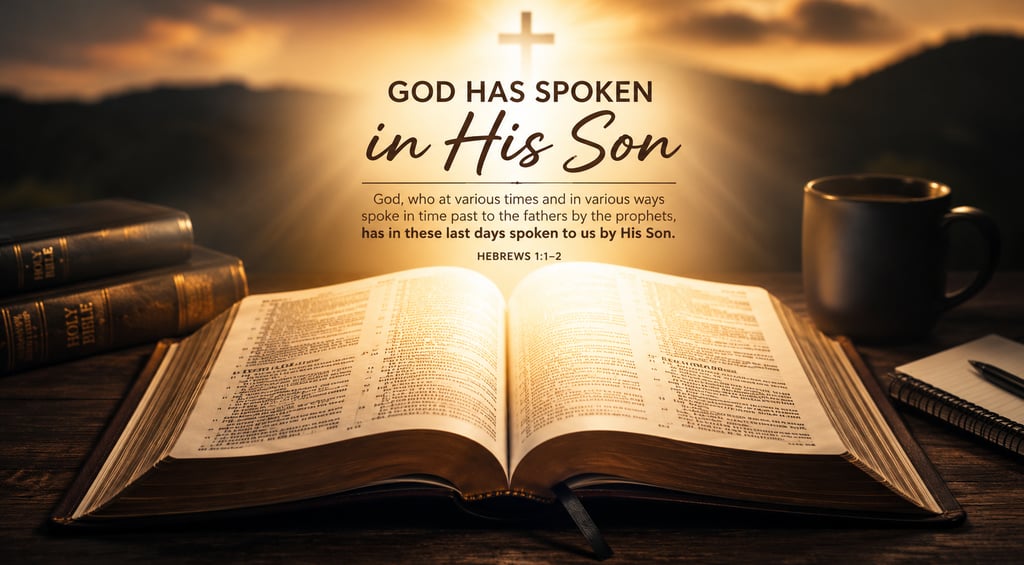
Hebrews 1:1–2 says:
“God, who at various times and in various ways spoke in time past to the fathers by the prophets, has in these last days spoken to us by His Son.”
This is one of the most important passages in the entire discussion.
The writer of Hebrews contrasts the former way God spoke with the climactic way God has now spoken. In the past, God spoke “at various times and in various ways.” He spoke through dreams, visions, angels, prophets, signs, types, shadows, ceremonies, and inspired messengers. But “in these last days,” God has spoken “by His Son.”
This does not mean merely that Jesus was one more prophet added to the list. It means Jesus is the fulfillment of the prophetic word. He is not simply another messenger; He is the final and supreme revelation of God. The Son does not merely bring a word from God. He is the Word made flesh.
This matters deeply. If the Son is God’s climactic revelation, then we should not think of New Covenant Christianity as an unfinished religious system still dependent on continuing prophetic additions. The apostles were appointed by Christ to bear authoritative witness to Him, and that apostolic witness became the foundation of the church.
Ephesians 2:20 says that the household of God has been:
“built on the foundation of the apostles and prophets, Jesus Christ Himself being the chief cornerstone.”
A foundation is not laid again and again. It is laid at the beginning. Once the foundation is laid, the building is built upon it. The apostles and prophets were not ordinary repeating offices for every generation in the same foundation-laying sense. They belonged to the once-for-all establishment of the New Covenant church.
Jesus Christ is the cornerstone. The apostles and prophets bore authoritative witness to Him. The church now continues not by receiving new foundational revelation, but by remaining faithful to the revelation already given.
2. Daniel 9 Anticipates the Sealing Up of Vision and Prophecy
Daniel 9 is not always brought into this discussion, but it should be. In Daniel 9:24, Gabriel tells Daniel:
“Seventy weeks are determined for your people and for your holy city,
To finish the transgression,
To make an end of sins,
To make reconciliation for iniquity,
To bring in everlasting righteousness,
To seal up vision and prophecy,
And to anoint the Most Holy.”
This prophecy moves toward the coming of Messiah and the accomplishment of redemption. It speaks of transgression being finished, sins being dealt with, iniquity being reconciled, everlasting righteousness being brought in, and “vision and prophecy” being sealed up.
The phrase “to seal up vision and prophecy” is significant. In Scripture, to seal something can mean to authenticate it, bring it to completion, or close it up as fulfilled. Daniel is being told that the redemptive work of Messiah would bring the prophetic era to its intended goal.
This does not mean no prophet spoke after Daniel. Clearly, prophets still spoke after Daniel. But Daniel 9 is looking forward to the Messianic fulfillment, when the great redemptive realities promised by God would be accomplished. When Christ came, died, rose again, ascended, poured out the Spirit, and commissioned His apostles, God was bringing the prophetic program to its appointed fulfillment.
That is why cessationism is not a theory about God becoming inactive. It is an argument from fulfillment.
God promised. God revealed. God prepared. God sent His Son. God authenticated His Son and His apostles. God gave the apostolic witness. And now God calls His people to hear, believe, obey, guard, and proclaim that once-delivered faith.
Jude 3 speaks of:
“the faith which was once for all delivered to the saints.”
The faith was not partially delivered, waiting for later prophets to complete it. It was once for all delivered. The church’s task is not to keep adding revelation, but to contend earnestly for the revelation God has already given.
3. The Apostles Had a Unique, Non-Repeatable Role
The New Testament apostles were not merely gifted Christian leaders. They were personally commissioned representatives of Christ with unique authority.
In Acts 1, when Judas is replaced, Peter gives qualifications for the replacement apostle. The man had to have accompanied the disciples during the earthly ministry of Jesus and had to be a witness of the resurrection. Paul later defends his apostleship on the basis that he had seen the risen Christ and was directly commissioned by Him.
That means the apostolic office was not designed to continue indefinitely. It belonged to those whom Christ personally appointed as His authoritative witnesses.
This also explains the relationship between apostles and signs.
2 Corinthians 12:12 says:
“Truly the signs of an apostle were accomplished among you with all perseverance, in signs and wonders and mighty deeds.”
Notice the phrase: “the signs of an apostle.” Signs and wonders were not random spiritual fireworks. They were divine attestations. They marked the apostolic witness as truly from God.
Hebrews 2:3–4 says:
“How shall we escape if we neglect so great a salvation, which at the first began to be spoken by the Lord, and was confirmed to us by those who heard Him, God also bearing witness both with signs and wonders, with various miracles, and gifts of the Holy Spirit, according to His own will?”
This passage is very important. The great salvation was first spoken by the Lord. It was then confirmed by those who heard Him—namely, the apostolic witnesses. God bore witness to their message by signs, wonders, miracles, and gifts of the Holy Spirit.
The signs were not ends in themselves. They were witnesses. They confirmed the message and the messengers during the establishment of the New Covenant church.
Once the message has been confirmed, and once the apostolic foundation has been laid, we should not expect the same foundation-confirming signs to continue as ordinary gifts throughout all generations.
God can still heal. God can still do wonders. God can still answer prayer in remarkable ways. But that is different from saying that the church still possesses ongoing revelatory and sign gifts as ordinary offices or abilities.
4. Tongues Were a Sign, Not a Private Badge of Spirituality
Tongues are often misunderstood today. Many think of tongues mainly as a private prayer language or as proof that someone has received a higher spiritual experience. But the Bible presents tongues differently.
In Acts 2, tongues were real human languages understood by people from many nations. The miracle was not meaningless sound; it was intelligible speech declaring “the wonderful works of God” to people from different linguistic backgrounds.
This matters because Pentecost was a redemptive-historical event. God was showing that the gospel of Christ was not confined to one nation. The risen Christ was gathering His people from the nations by His Spirit.
In 1 Corinthians 14:21–22, Paul connects tongues to Isaiah 28:
“In the law it is written:
‘With men of other tongues and other lips
I will speak to this people;
And yet, for all that, they will not hear Me,’ says the Lord.
Therefore tongues are for a sign, not to those who believe but to unbelievers.”
Tongues were a sign. In context, especially a sign of judgment upon unbelieving Israel and a sign that God was now speaking His mighty works among the nations.
This is why tongues appear at key moments in Acts: Jews at Pentecost, Samaritans, Gentiles in Cornelius’s house, and disciples connected to John’s baptism. These moments are not random. They show the gospel moving outward according to Christ’s promise in Acts 1:8:
“You shall be witnesses to Me in Jerusalem, and in all Judea and Samaria, and to the end of the earth.”
Tongues marked the expansion of the New Covenant people of God. They were not given so that Christians could prove they were more spiritual than other Christians. Nor were they given so that every church service would be filled with unintelligible speech.
In fact, Paul restricts tongues very strongly in 1 Corinthians 14. He requires interpretation. He requires order. He says God is not the author of confusion but of peace. He says he would rather speak five understandable words than ten thousand in a tongue.
That alone should make us cautious. Much of what is called tongues today does not resemble the biblical gift. Biblical tongues were intelligible languages, sign gifts, and subject to apostolic regulation.
5. Prophecy Was Revelation from God, Not Fallible Guesswork
Another common modern claim is that New Testament prophecy can be partly mistaken. Some say a person may receive a prophecy from God but deliver it imperfectly, so the prophecy may contain errors.
That view creates a serious problem.
In Scripture, when God gives revelation, God’s word is true. The weakness of man does not make God’s revelation uncertain. The Old Testament standard for prophecy was severe because the prophet claimed to speak from God. Deuteronomy 18:22 says:
“When a prophet speaks in the name of the LORD, if the thing does not happen or come to pass, that is the thing which the LORD has not spoken.”
The issue was not whether the prophet had good intentions. The issue was whether the word was from the Lord.
In the New Testament, prophecy also involved revelation. 1 Corinthians 14:29–30 says:
“Let two or three prophets speak, and let the others judge. But if anything is revealed to another who sits by, let the first keep silent.”
Paul uses the language of revelation. Prophecy was not merely preaching. Preaching explains and applies the already-given Word of God. Prophecy, in the biblical sense, communicated revelation from God.
That is why ongoing prophecy creates such a major issue. If prophecy still continues as revelation from God, then the church still receives revelation beyond Scripture. If that revelation is truly from God, it carries divine authority. If it can be mistaken, then it is not biblical prophecy.
We cannot have it both ways. Either prophecy is revelation from God and therefore true, or it is fallible human impression and should not be called prophecy in the biblical sense.
The church does not need new revelation. The church needs faithful illumination, exposition, understanding, obedience, and courage to believe what God has already revealed.
The Holy Spirit still works powerfully through the Word. He convicts. He comforts. He illumines. He sanctifies. He gives wisdom. He leads God’s people by Scripture. But illumination is not the same as revelation. The Spirit opening our eyes to understand the Bible is not the same thing as the Spirit giving new Scripture-quality words through modern prophets.
6. 1 Corinthians 13 Teaches That Partial Revelatory Gifts Would Cease
One of the most debated passages in this discussion is 1 Corinthians 13:8–10:
“Love never fails. But whether there are prophecies, they will fail; whether there are tongues, they will cease; whether there is knowledge, it will vanish away. For we know in part and we prophesy in part. But when that which is perfect has come, then that which is in part will be done away.”
Paul clearly says that prophecies, tongues, and knowledge would not continue forever. They belonged to the “in part” stage. The question is: when does “that which is perfect” come?
Some argue that “the perfect” refers only to the second coming of Christ. Others argue that it refers to the maturity or completion of the church’s revelatory foundation. We should be careful and honest: faithful Christians have disagreed about the exact interpretation of this phrase.
However, several things should be observed.
First, Paul is discussing revelatory gifts—prophecy, tongues, and knowledge. These gifts gave partial revelation. They were real, but they were not the final state of the church’s knowledge.
Second, the Greek word translated “perfect” is teleion, which carries the idea of maturity, completion, or reaching the intended goal. It does not always mean absolute heavenly perfection. The context must decide.
Third, Paul contrasts partial modes of revelation with a state of greater fullness. During the apostolic period, the church did not yet possess the completed New Testament canon. Revelation was still being given through apostles and prophets. But as the apostolic foundation was completed, the church moved from partial revelatory fragments to the completed apostolic deposit.
Fourth, even if someone argues that the ultimate fullness awaits Christ’s return, this passage still proves that tongues and prophecy were temporary gifts. It does not prove they must continue throughout the entire church age. Paul says they cease; other passages help us understand why and when.
So 1 Corinthians 13 should be read together with Hebrews 1, Hebrews 2, Ephesians 2, Daniel 9, Jude 3, and the historical pattern of Acts. When we do that, the picture becomes clearer. The revelatory and sign gifts belonged to the foundation-laying and message-confirming period of the church. They were glorious gifts for their appointed purpose. But they were never meant to replace the completed Word of God as the church’s ordinary guide.
7. The Pattern of Scripture Shows Clusters of Miracles at Major Redemptive Moments
Another helpful observation is that miracles in Scripture are not evenly spread across biblical history. They often cluster around major moments of revelation and redemption.
We see major clusters around Moses and the Exodus, Elijah and Elisha during a time of covenant crisis, Christ and His earthly ministry, and the apostles during the establishment of the New Covenant church.
That pattern teaches us something. Miracles often served to authenticate God’s messengers and mark major transitions in redemptive history.
Moses was authenticated before Pharaoh and Israel. Elijah and Elisha were authenticated during a period of deep covenant apostasy. Christ’s miracles testified that the kingdom of God had come in Him. The apostles’ signs testified that they were Christ’s authorized witnesses.
John 20:30–31 says:
“And truly Jesus did many other signs in the presence of His disciples, which are not written in this book; but these are written that you may believe that Jesus is the Christ, the Son of God.”
The signs pointed to Christ. They were not entertainment. They were not spiritual performance. They were revelation in action, testifying to the identity and mission of the Son of God.
The apostles then bore witness to the crucified and risen Christ. Their signs confirmed their message. Once that witness was established and inscripturated, the church was not left poor. She was left rich—with the complete written Word of God.
8. The Sufficiency of Scripture Is Not a Weak Doctrine
Some Christians fear that cessationism makes the Christian life less alive. But that fear usually comes from underestimating what Scripture is.
The Bible is not a dead letter. It is the living Word of the living God. Hebrews 4:12 says:
“For the word of God is living and powerful, and sharper than any two-edged sword.”
2 Timothy 3:16–17 says:
“All Scripture is given by inspiration of God, and is profitable for doctrine, for reproof, for correction, for instruction in righteousness, that the man of God may be complete, thoroughly equipped for every good work.
This does not mean we do not need pastors, teachers, wisdom, prayer, fellowship, or the inward work of the Spirit. We need all of those. But those ministries do not add new revelation. They help us understand, believe, obey, and apply the revelation God has already given.
The Spirit has not become silent. He speaks in Scripture. He illumines Scripture. He convicts by Scripture. He comforts by Scripture. He sanctifies by Scripture. He leads the people of God by the Word He Himself inspired.
Jesus prayed in John 17:17, “Sanctify them by Your truth. Your word is truth.” The ordinary Christian life is not built on chasing new messages from heaven, but on being sanctified by the truth God has already spoken.
So cessationism is not a low view of the Spirit. It is a high view of the Spirit’s completed work of revelation. It says that the same Holy Spirit who gave the prophets and apostles now calls the church to receive, guard, preach, sing, pray, and obey the written Word of God.
© Copyright 2026 | All Rights Reserved | Christ Centered Reformed Ministries
Contact Us